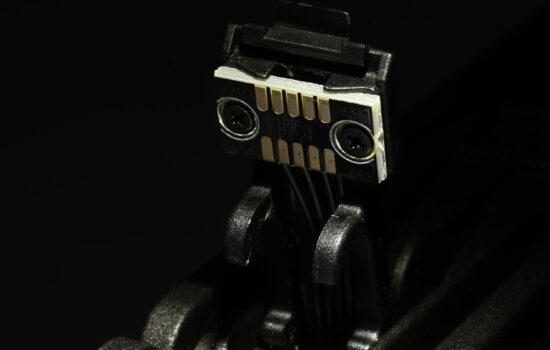
Blades, hub—everywhere there are features disrupting an otherwise smooth design. This kind of detailing defines the HAVN H12 at first glance—and the second impression is just as striking. With the kind of geometry the H12 brings to the table, reaching the absolute top tier is possible. In practice, however, it’s essential to find the right scenarios and fine-tune the right settings to end up truly satisfied.
Evaluation
In certain scenarios, the HAVN H12 achieves top-tier results—especially considering its price of around 19 EUR. Without obstacles at roughly 800 RPM and low noise levels (33 dBA mode), it ranks in the top five—just one position behind the Noctua NF-A12x25 G2 PWM. A similar pattern applies on a grille, though in many other cases results are merely average—for example on radiators. Still, airflow through them—both thinner (higher FPI) and thicker (lower FPI)—often lands in the upper half of results, which is a respectable showing given the extensive 120 mm fan database. You’ll have to judge for yourself.
One thing is certain—greater thickness reduces compatibility, much like with the Phanteks T30-120. Sometimes this doesn’t matter, sometimes it does—it depends on the build. In system positions, fan thickness is usually less critical, and 30 mm is still generally acceptable. The HAVN H12 handles the grille well, as well as dust filters—both nylon and plastic. Results here are no longer top-tier, but given the price—and compared to similar competitors—they remain attractive. Or do they?
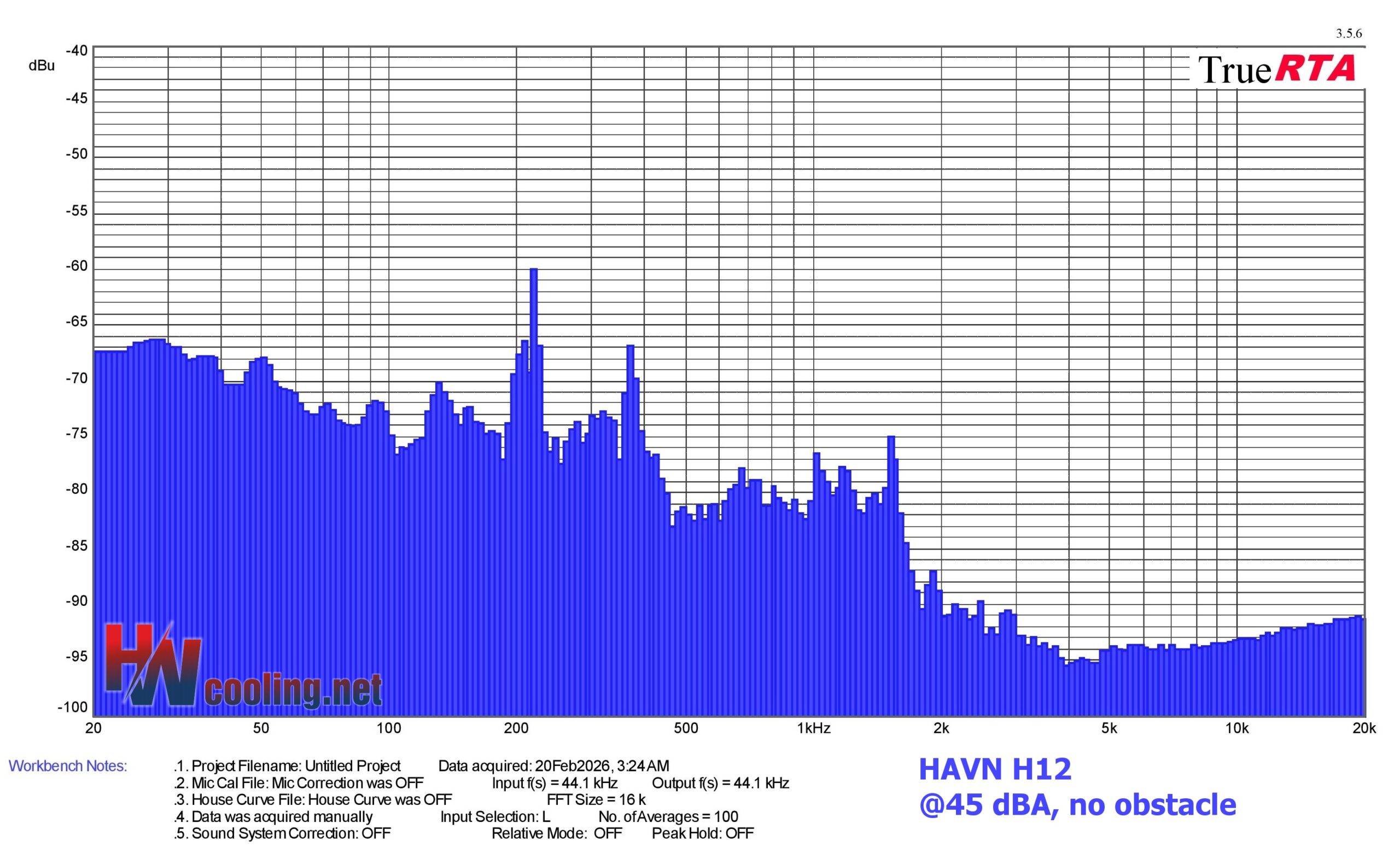
The acoustic profile is relatively unobtrusive, although more pronounced tonal peaks appear just above 200 Hz at higher speeds. That’s also the case with fans such as the Nidec Servo Gentle Typhoon D1225C and the Adata XPG Vento Pro. Competing LCP fans, including the Scythe Grand Tornado 120, often perform better here, with less noise at these frequencies.

Outside of maximum speed—while still delivering high airflow—vibration transmitted to the fame is negligible. This is thanks not only to the rigid construction material, but also to precise manufacturing and accurate centering of critical components.
Power consumption is average—exactly what you’d expect. If anything stands out about the motor, it’s its output. It reaches over eleven watts. That leaves substantial headroom for long-term wear as internal friction increases with use. Minimum speeds around 500 RPM are relatively low, and the fan still supports passive operation—once PWM duty cycle drops below a certain threshold, the motor shuts off.
On behalf of the HWCooling editorial team, we can praise the HAVN H12—though it doesn’t climb higher than the “Approved” award.
English translation and edit by Jozef Dudáš
| HAVN H12 |
| + Suitable for any use |
| + Cooling efficiency (airflow/pressure per unit of noise) at a very high level |
| + High airflow and static pressure even through restrictive obstacles... |
| + ... top-tier efficiency around 800 RPM |
| + Attractive price-to-performance ratio given peak results |
| + Very high build quality |
| + Truly powerful motor (~11 W) |
| + Wide speed range |
| - More pronounced rumbling at high speeds |
| - Potentially reduced compatibility due to above-standard thickness |
| Approximate retail price: 19 EUR |
PC fans are also availablefor purchase at the Datacomp e-store