


Some really attractive things are often overlooked or given less attention than they deserve, for various reasons. This is somewhat the case with the technically remarkable fan from PCCooler CPS – the F5 R120. This 120 mm fan with its features is in the company of the most prominent names, although it has its weaknesses as well. These may or may not interest you either. It depends on the use case.
33 dBA or 33 dBA
The noise level, given as a single dBA value, is good for quick reference, but it doesn’t give you an idea of exactly what the sound sounds like. That’s because it averages a mix of noise levels of all frequencies of sound. One fan may disturb you more than the other, even though they both reach exactly the same dBA, yet each is characterized by different dominant (louder) frequencies. To analyze thoroughly with an idea of the “color” of the sound, it is essential to record and assess noise levels across the entire spectrum of frequencies that we perceive.

We already do this in graphics card tests, and we’ll do it for fans too, where it makes even more sense. Using the UMIK-1 miniDSP microphone and TrueRTA’s mode-specific, fixed dBA application, we also measure which frequencies contribute more and which contribute less to the sound. The monitored frequency range is 20-20,000 Hz, which we’ll work with at a fine resolution of 1/24 octave. In it, noise levels from 20 Hz to 20 000 Hz are captured at up to 240 frequencies.
The information captured in the spectrograph is a bit more than we will need for clear fan comparisons. While you’ll always find a complete spectrograph in the tests, we’ll only work with the dominant frequencies (and their noise intensities) in the low, mid, and high bands in the comparison tables and charts. The low frequency band is represented by 20–200 Hz, the medium by 201–2000 Hz and the high by 2001–20 000 Hz. From each of these three bands, we select the dominant frequency, i.e. the loudest one, which contributes most to the composition of the sound.
To the dominant frequency we also give the intensity of its noise. However, in this case it is in a different decibel scale than those you are used to from noise meter measurements. Instead of dBA, we have dBu. This is a finer scale, which is additionally expressed negatively. Be careful of this when studying the results – a noise intensity of -70 dBu is higher than -75 dBu. We discussed this in more detail in the article Get familiar with measuring the frequency response of sound.
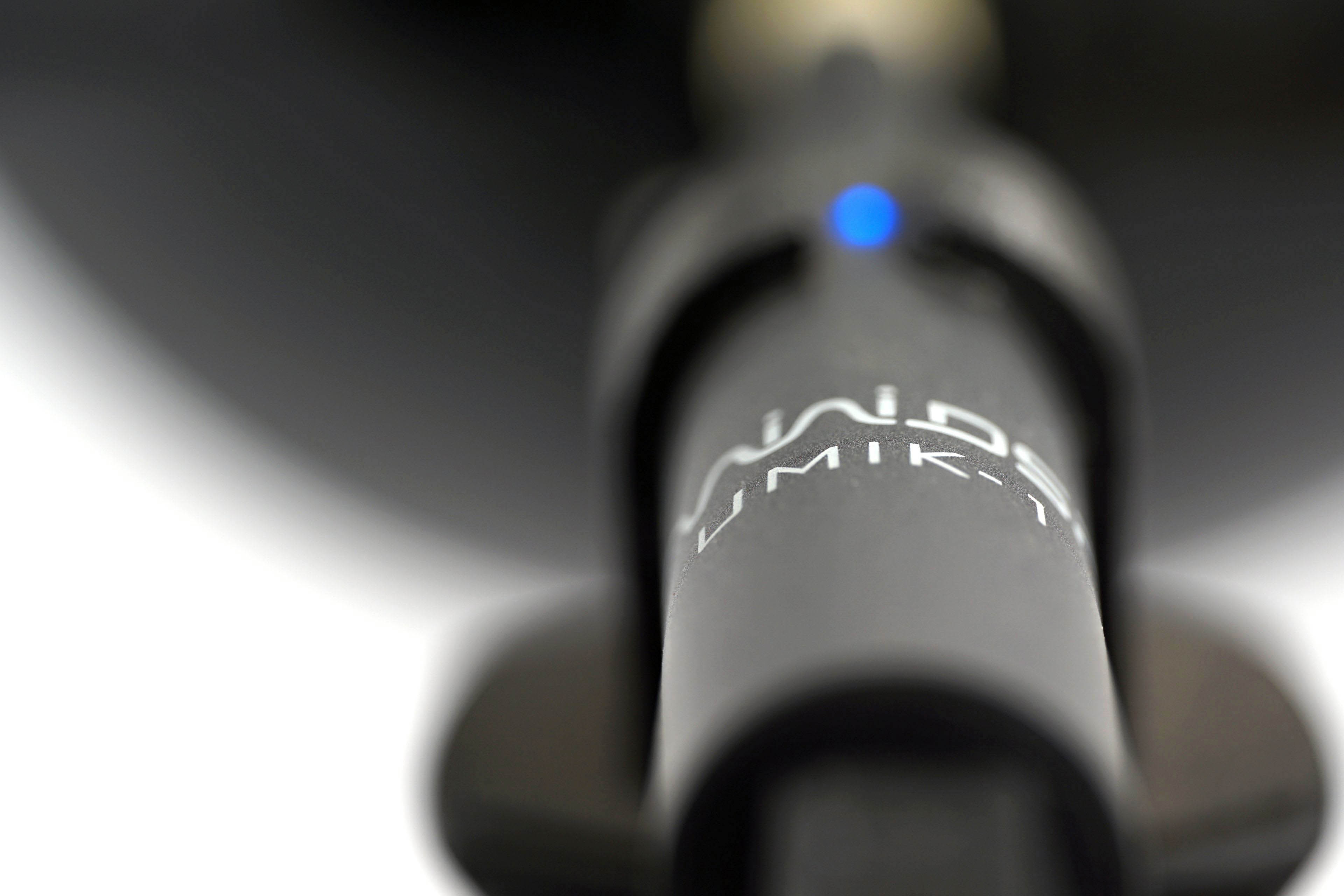
Strict acoustic safeguards are required to ensure that these measurements can be carried out with satisfactory repeatability at all. We use acoustic panels to measure the same values at all frequencies across repeated measurements. These ensure that the sound is always reflected equally to the microphone regardless of the distribution of other objects we have in the testlab. The baseline noise level before each measurement is also naturally the same. The room in which we measure is soundproofed.
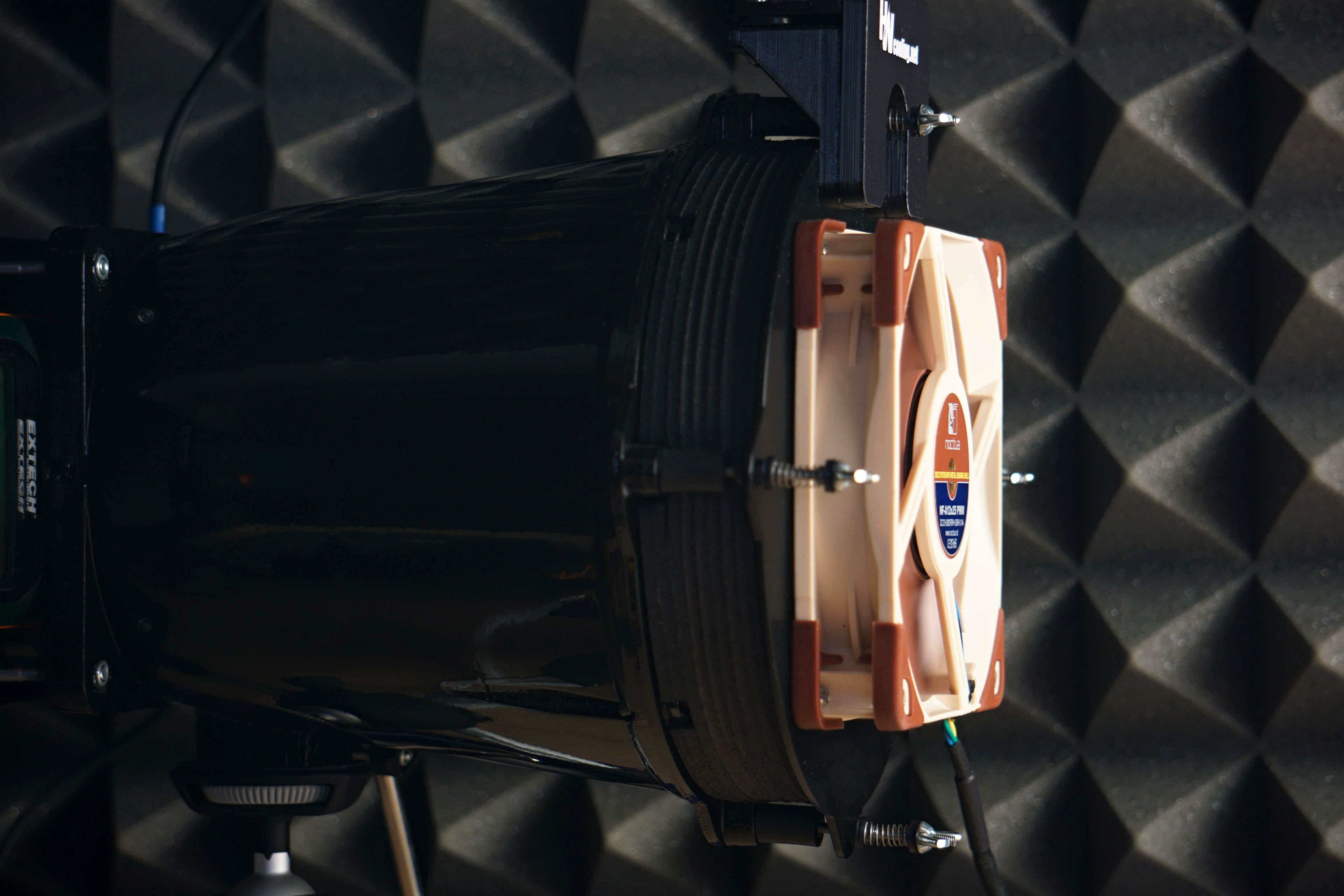
Like the noise meter, the microphone has a parabolic collar to increase resolution. The latter is specially in this case not only to amplify but also to filter out the noises that occur whether we want them or not behind the microphone. We are talking about the physical activity of the user (tester). Without this addition, human breathing, for example, would also be picked up by the spectrograph. However, this is successfully reflected off the microphone sensor by the back (convex) side of the collar. As a result, the spectrogram only contains information about the sound emitted by the fan itself.




That’s a very a good fan overall. No noticeable weakness with decent noise profile, at a highly competitive price point. I’m surprised that a PBT only fan without an outer ring can perform this well. I wonder how the Arctic P12 Max compares (maybe it’s comparable to the ARGB version?)
P.S. Frequency plots aren’t accessible in the English version, and most (all?) links in the conclusion page are broken due to lacking -bk.
Thanks! Fixed. 🙂
The motor sound link is still broken. It’s the first plot in the “hexagonal grille” page, right?
So, this sound only appears when speed is very close to the minimum RPM? I don’t think I’ve seen this behaviour before, interesting. It should be easily avoidable by the user, but can be limiting for those who want an extremely quiet build.
Haha, no mistake escapes you. What a great thing that we have such attentive readers. 🙂
And yes, it’s the first spectrogram with the hexagonal grille. This mode has the lowest fan speed at which frequency analysis of sound is measured. Several fans with typically cheaper motors are struggling at the lower speed limit and this behaviour is accompanied by such annoying sounds. I don’t always point it out, but here it was extra interesting especially in the context of high efficiency at very low speeds. When you go from that optimum 700 rpm down to somewhere near 550 rpm, it may not be so great anymore. Because of that annoying motor sound that adds to the well audible spectrum.
The blades of the F5 R120 are relatively short yet thick. Although we did measure some vibration, I don’t think it was due to the blades being “too flexible”. Something else will be behind their occurrence, maybe some manufacturing inaccuracies (around the axle for example) and such. The lower MTBF value would suggest this, but I don’t want to speculate on these things.
What is obvious, however, is that even a cheap fan with shorter PBT blades doesn’t have to be the source of any vibration. We have already been convinced of this by a test of 15 Stratus 1220 PWMs, where the variance of vibration across the samples is very wide. But it is given by the high tolerances. If the vibrations were due to blade undulations, we would never, on any piece, measure 0.000. And in that one case (the gold sample) this happened even at maximum speed with a fairly high (1600) RPM.
Strongly recommand you to add the 9RA1212P4G001, and maybe the 9RA1212P1K001 and 9RA1412P1G001 from Sanyo into the compaing list.
Thank you for the useful tips. We will definitely take a look at the fans and try to add them to the results database. I can’t promise when this might happen, but we will contact Sanyo and see.