


Some really attractive things are often overlooked or given less attention than they deserve, for various reasons. This is somewhat the case with the technically remarkable fan from PCCooler CPS – the F5 R120. This 120 mm fan with its features is in the company of the most prominent names, although it has its weaknesses as well. These may or may not interest you either. It depends on the use case.
Base 6 equal noise levels…
There are several options by which to normalize the test modes for fans. In the previous chapter, we wrote that perhaps the least appropriate option is equal speed.
Settings according to the same static pressure or flow are for consideration, but we find it most sensible in the long term to normalize the measurement modes according to the same noise levels. Firstly because decibels are a logarithmic unit and all others scale linearly, but mainly because you can orientate fastest by the same noise levels. The easiest way to compare the efficiency of fans is just by how they perform at the same sound pressure level. Of all the options, this is the one that most people can best imagine and bounce off of when considering other variables.
The individual noise level modes are adjusted from low levels continuously to higher levels. All users will find their results in the tests, regardless of whether they prefer very quiet operation at the limit of audibility or whether high performance is paramount.
The quietest mode corresponds to 31 dBA, followed by 33 dBA, and for each additional mode we add 3 dBA, which always doubles the noise level (36, 39, 42 and 45 dBA). Finally, we measure the fans at maximum power. Here, each one already has a slightly different noise level, which we also report. If there are missing measurements between the results for any of the fans, this means that it was not possible to set the target noise level. Either because its minimum speed exceeds the quietest mode of 31 dBA or vice versa because the fan is quieter than 45 dBA at maximum power.
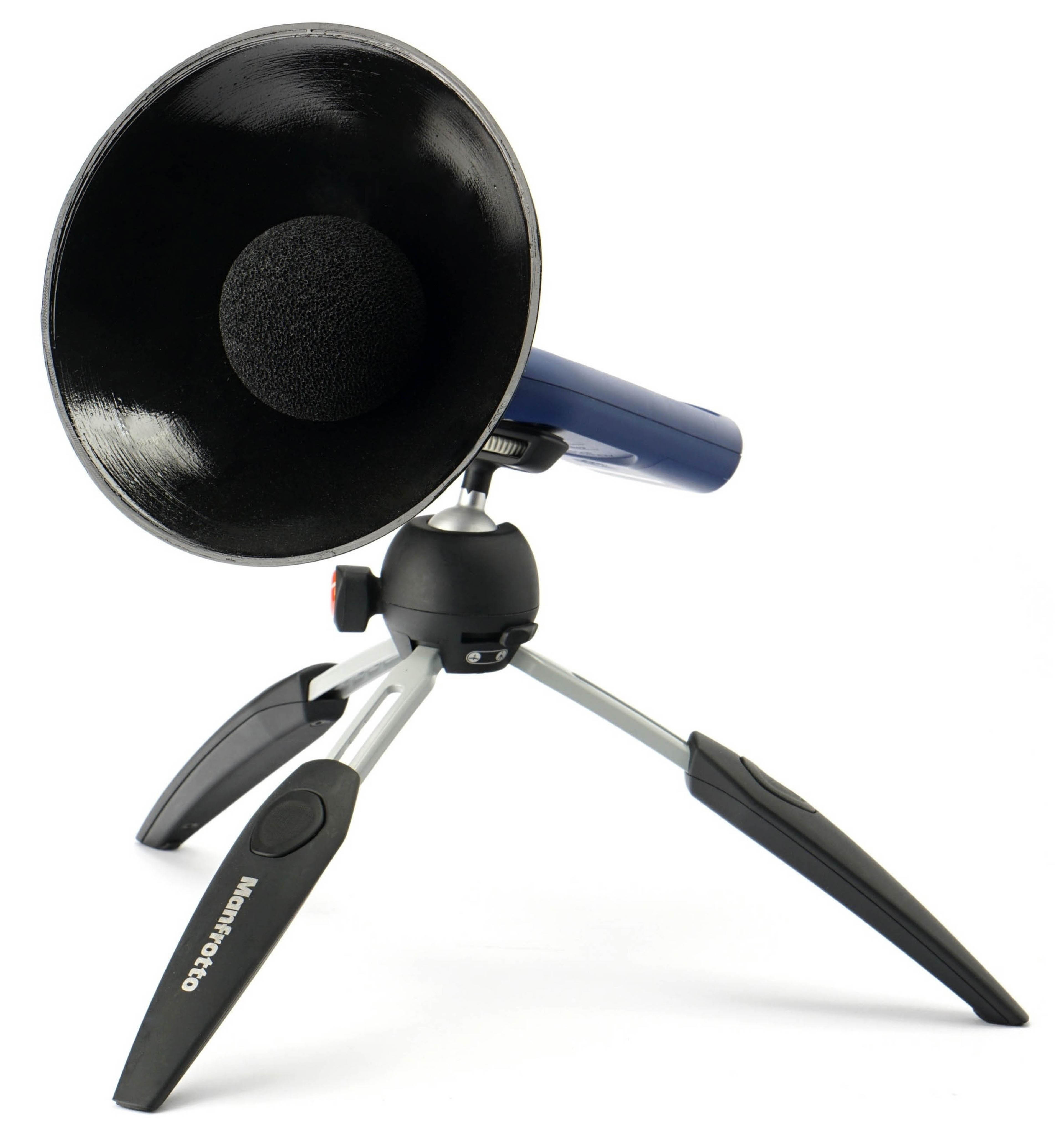
It is important to add that our noise level measurements are incomparable to the values quoted by the fan manufacturers in their specifications. One of the reasons is because we use a parabola-shaped collar around the sensor of the noise meter, which increases sensitivity. This is important in order to distinguish and set to the same noise level even modes at very low speeds, especially 31 dBA.
The noise meter next to the fan is quite close for sufficient resolution. The distance between the frame and the sensor is 15 centimeters. The sensor is positioned in such a way that there is no distortion or that the noise level measurements are not affected by airflow. Therefore, the noise meter is centered perpendicularly to the frame that defines the depth of the fan. Everything is always at the same angle and at the same distance. We use an inclinometer and markers to set the distances precisely and always the same.

We use a Reed R8080 noise meter to measure noise levels. This allows real-time averaging of samples, which is important for fine-tuning individual modes. We tune the fans until the specified noise level is reached to two decimal places, for example 31.50 dBA. The noise meter is the only instrument we calibrate inside our testlab. The other instruments have been calibrated by the relevant technical institutes. However, in the case of the noise meter, calibration is required before each test and we therefore have our own calibrator. This is already calibrated externally according to the standard.




That’s a very a good fan overall. No noticeable weakness with decent noise profile, at a highly competitive price point. I’m surprised that a PBT only fan without an outer ring can perform this well. I wonder how the Arctic P12 Max compares (maybe it’s comparable to the ARGB version?)
P.S. Frequency plots aren’t accessible in the English version, and most (all?) links in the conclusion page are broken due to lacking -bk.
Thanks! Fixed. 🙂
The motor sound link is still broken. It’s the first plot in the “hexagonal grille” page, right?
So, this sound only appears when speed is very close to the minimum RPM? I don’t think I’ve seen this behaviour before, interesting. It should be easily avoidable by the user, but can be limiting for those who want an extremely quiet build.
Haha, no mistake escapes you. What a great thing that we have such attentive readers. 🙂
And yes, it’s the first spectrogram with the hexagonal grille. This mode has the lowest fan speed at which frequency analysis of sound is measured. Several fans with typically cheaper motors are struggling at the lower speed limit and this behaviour is accompanied by such annoying sounds. I don’t always point it out, but here it was extra interesting especially in the context of high efficiency at very low speeds. When you go from that optimum 700 rpm down to somewhere near 550 rpm, it may not be so great anymore. Because of that annoying motor sound that adds to the well audible spectrum.
The blades of the F5 R120 are relatively short yet thick. Although we did measure some vibration, I don’t think it was due to the blades being “too flexible”. Something else will be behind their occurrence, maybe some manufacturing inaccuracies (around the axle for example) and such. The lower MTBF value would suggest this, but I don’t want to speculate on these things.
What is obvious, however, is that even a cheap fan with shorter PBT blades doesn’t have to be the source of any vibration. We have already been convinced of this by a test of 15 Stratus 1220 PWMs, where the variance of vibration across the samples is very wide. But it is given by the high tolerances. If the vibrations were due to blade undulations, we would never, on any piece, measure 0.000. And in that one case (the gold sample) this happened even at maximum speed with a fairly high (1600) RPM.
Strongly recommand you to add the 9RA1212P4G001, and maybe the 9RA1212P1K001 and 9RA1412P1G001 from Sanyo into the compaing list.
Thank you for the useful tips. We will definitely take a look at the fans and try to add them to the results database. I can’t promise when this might happen, but we will contact Sanyo and see.