


Some really attractive things are often overlooked or given less attention than they deserve, for various reasons. This is somewhat the case with the technically remarkable fan from PCCooler CPS – the F5 R120. This 120 mm fan with its features is in the company of the most prominent names, although it has its weaknesses as well. These may or may not interest you either. It depends on the use case.
How we measure power draw…
Is it worth addressing the power draw of fans? If you have seven of them in your computer (three on the radiator of the cooler and four for system cooling in the case) and they are also backlit, the power draw starts at tens of watts. This makes it worth dealing with.
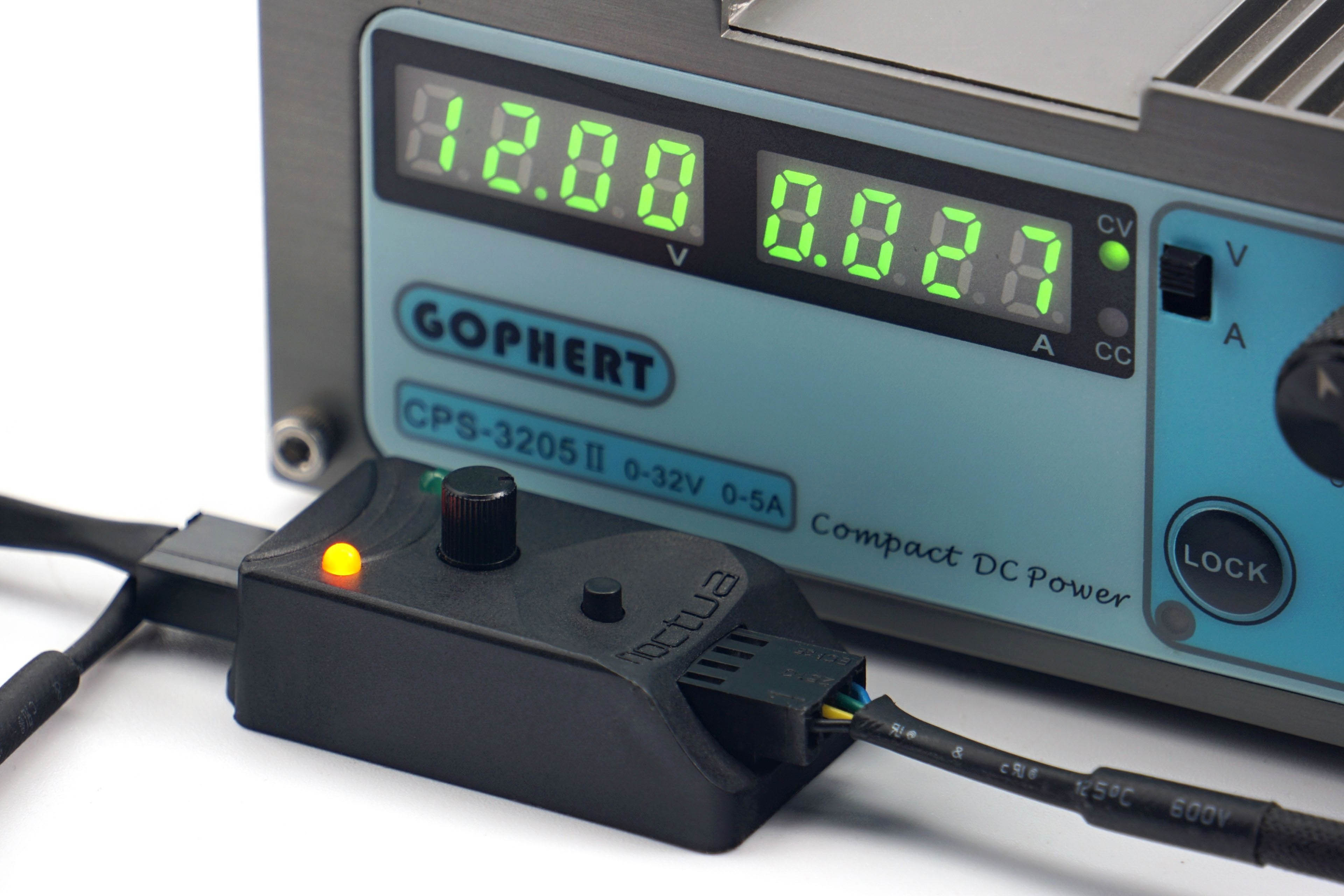
All fans are powered by Gophert CPS-3205 II laboratory power supply. It is passive and virtually noiseless, so it does not distort our noise level measurements. However, for the PWM fans, a Noctua NA-FC1 controller is connected through which the fans are regulated. We also have a shunt between the power supply and the Noctua controller. On it, we read the voltage drop, from which we then calculate the current. However, the voltage on the power supply is set so that 12 V goes to the Noctua NA-FC1. We then also set the exact 12 V to measure the maximum power of the 3-pin linear power supply fans.
In the power draw tests, we will be interested in the power draw in fixed noise level modes in addition to the maximum power consumption at 12 V or 100% PWM. That is, at those settings at which we also measure other parameters. Finally, in the graphs you will also find the power consumption corresponding to the start-up and minimum speeds. The difference between these two settings is that at start-up speed you need to overcome the frictional forces, so the power draw is always higher than at minimum speed. At these, the fan is already running and just reduces power to just before a level where it stops.

These start-up and minimum power draw data are a substitute for the start-up and minimum voltage information. You often encounter this when reading about fans, but with PWM fans there is no point in dealing with it. And although it is possible to power a PWM fan linearly, it will always perform better with PWM control – lower starting and minimum speeds. Therefore, it would be unfair to compare these parameters for all fans using linear control. That way, fans with PWM would be disadvantaged and the results distorted.
…and motor power
In addition to power draw, it is important to consider one more parameter that is related to the power supply – the power of the motor. This is usually listed on the back on a label and is often mistaken for power draw. However, the voltage and current indication here is usually not about power draw, but about the power of the motor. The latter must always be well above the operating power draw. The higher it is, the longer the life expectancy of the fan.
Over time and with wear, fan friction increases (through loss or hardening of the lubricant, dust contamination or abrasion of the bearings, etc.). However, a more powerful motor will overcome the deteriorating conditions of the fan to some extent, albeit at a higher power draw, but somehow it will cope. However, if the difference between the motor power and the operating power draw of a new fan is small, it may no longer be able to exert sufficient force to turn the impeller under increased friction due to adverse circumstances.

To test the power of the motor, we set the fan to full power (12 V/100 % PWM) and increase the mechanical resistance by braking the impeller in the middle. This is a higher load for the motor, with which the power draw naturally increases. But this is only up to a point, until the impeller stops. The power of the motor in our tests corresponds to the highest achieved power draw that we observed when the fan was being braked.
We use the Keysight U1231A high sample rate precision multimeters to analyse motor power (as well as normal operating power draw). In addition, the individual samples are recorded in a spreadsheet, from which we then graph the maximum. The final value is the average of three measurements (three maximums).




That’s a very a good fan overall. No noticeable weakness with decent noise profile, at a highly competitive price point. I’m surprised that a PBT only fan without an outer ring can perform this well. I wonder how the Arctic P12 Max compares (maybe it’s comparable to the ARGB version?)
P.S. Frequency plots aren’t accessible in the English version, and most (all?) links in the conclusion page are broken due to lacking -bk.
Thanks! Fixed. 🙂
The motor sound link is still broken. It’s the first plot in the “hexagonal grille” page, right?
So, this sound only appears when speed is very close to the minimum RPM? I don’t think I’ve seen this behaviour before, interesting. It should be easily avoidable by the user, but can be limiting for those who want an extremely quiet build.
Haha, no mistake escapes you. What a great thing that we have such attentive readers. 🙂
And yes, it’s the first spectrogram with the hexagonal grille. This mode has the lowest fan speed at which frequency analysis of sound is measured. Several fans with typically cheaper motors are struggling at the lower speed limit and this behaviour is accompanied by such annoying sounds. I don’t always point it out, but here it was extra interesting especially in the context of high efficiency at very low speeds. When you go from that optimum 700 rpm down to somewhere near 550 rpm, it may not be so great anymore. Because of that annoying motor sound that adds to the well audible spectrum.
The blades of the F5 R120 are relatively short yet thick. Although we did measure some vibration, I don’t think it was due to the blades being “too flexible”. Something else will be behind their occurrence, maybe some manufacturing inaccuracies (around the axle for example) and such. The lower MTBF value would suggest this, but I don’t want to speculate on these things.
What is obvious, however, is that even a cheap fan with shorter PBT blades doesn’t have to be the source of any vibration. We have already been convinced of this by a test of 15 Stratus 1220 PWMs, where the variance of vibration across the samples is very wide. But it is given by the high tolerances. If the vibrations were due to blade undulations, we would never, on any piece, measure 0.000. And in that one case (the gold sample) this happened even at maximum speed with a fairly high (1600) RPM.
Strongly recommand you to add the 9RA1212P4G001, and maybe the 9RA1212P1K001 and 9RA1412P1G001 from Sanyo into the compaing list.
Thank you for the useful tips. We will definitely take a look at the fans and try to add them to the results database. I can’t promise when this might happen, but we will contact Sanyo and see.