


So, we have results for a Thermalright fan. While the first attempt (or second, if we count the now-discontinued model X-Silent 120) didn’t quite hit the mark, it’s probably fair to say that this is a more attractive option than the Scythe Kaze Flex II 120. Yes, these two fans are being directly compared because they share an unusual trait – they spin in the “reverse” direction, from left to right. And as you know, most fans spin the other way…
Basis of the methodology, the wind tunnel
Before you start reading the methodology with all the details, take a look at the test tunnel as a whole. This is the heart of the whole system, to which other arteries are connected (manometer, vibrometer, powermeter, …). The only solid part of the tunnel from the measuring instruments is the anemometer.
The shape of the wind tunnel is inspired by the Venturi tube, which has long been used to measure the flow of liquids and gasses. The Venturi effect for wind speed measuring is also known from the aerospace industry. However, the design for measuring computer fans has its own specificities, which this proposal of ours reflects.
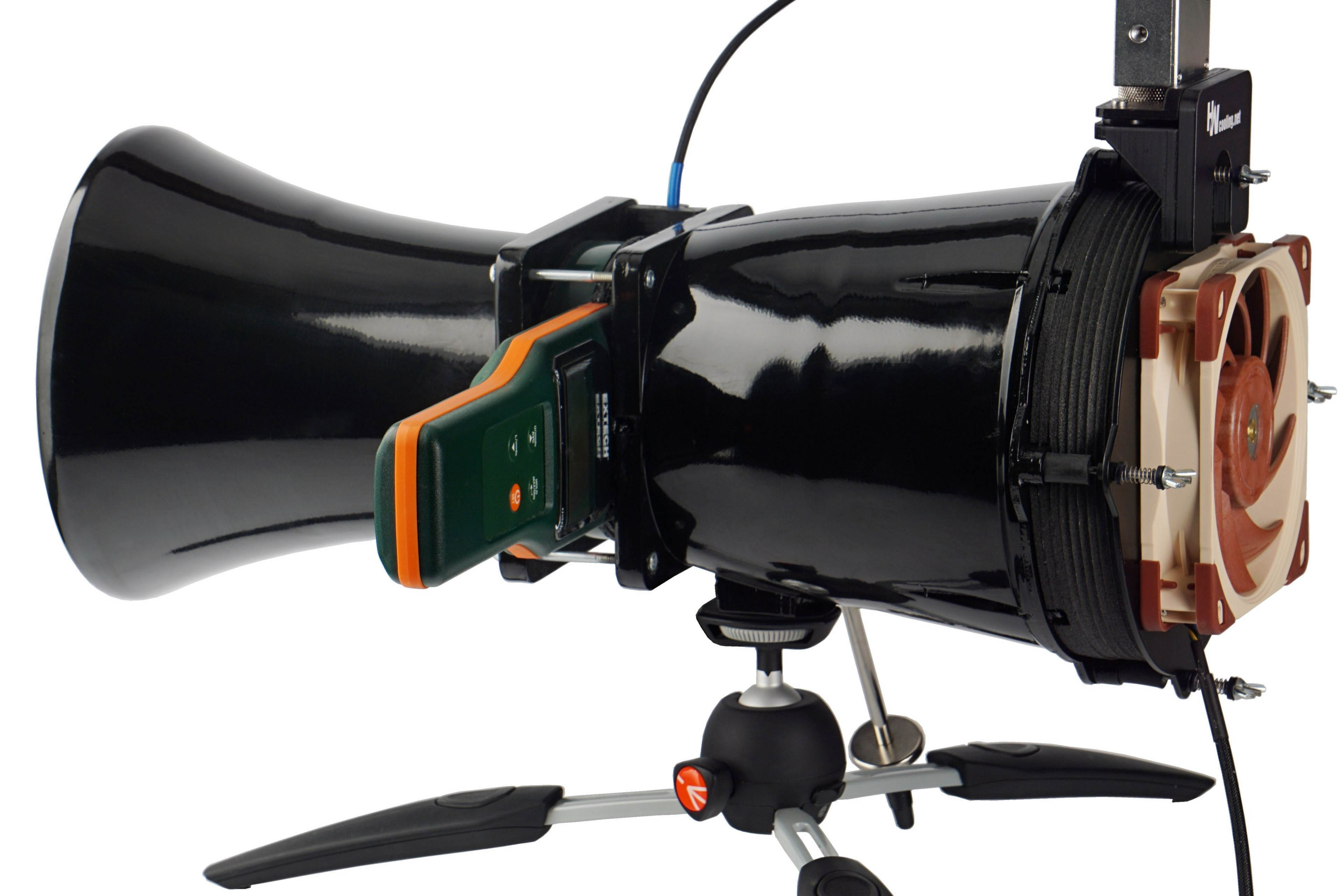
The individual parameters of the HWC wind tunnel for fan tests are the result of physical simulations and practical debugging. All the details (folds, material or finish used) have a rationale behind them and are designed this way for a specific reason. We will discuss the individual design details in turn in the description of the sub-variable measurements.
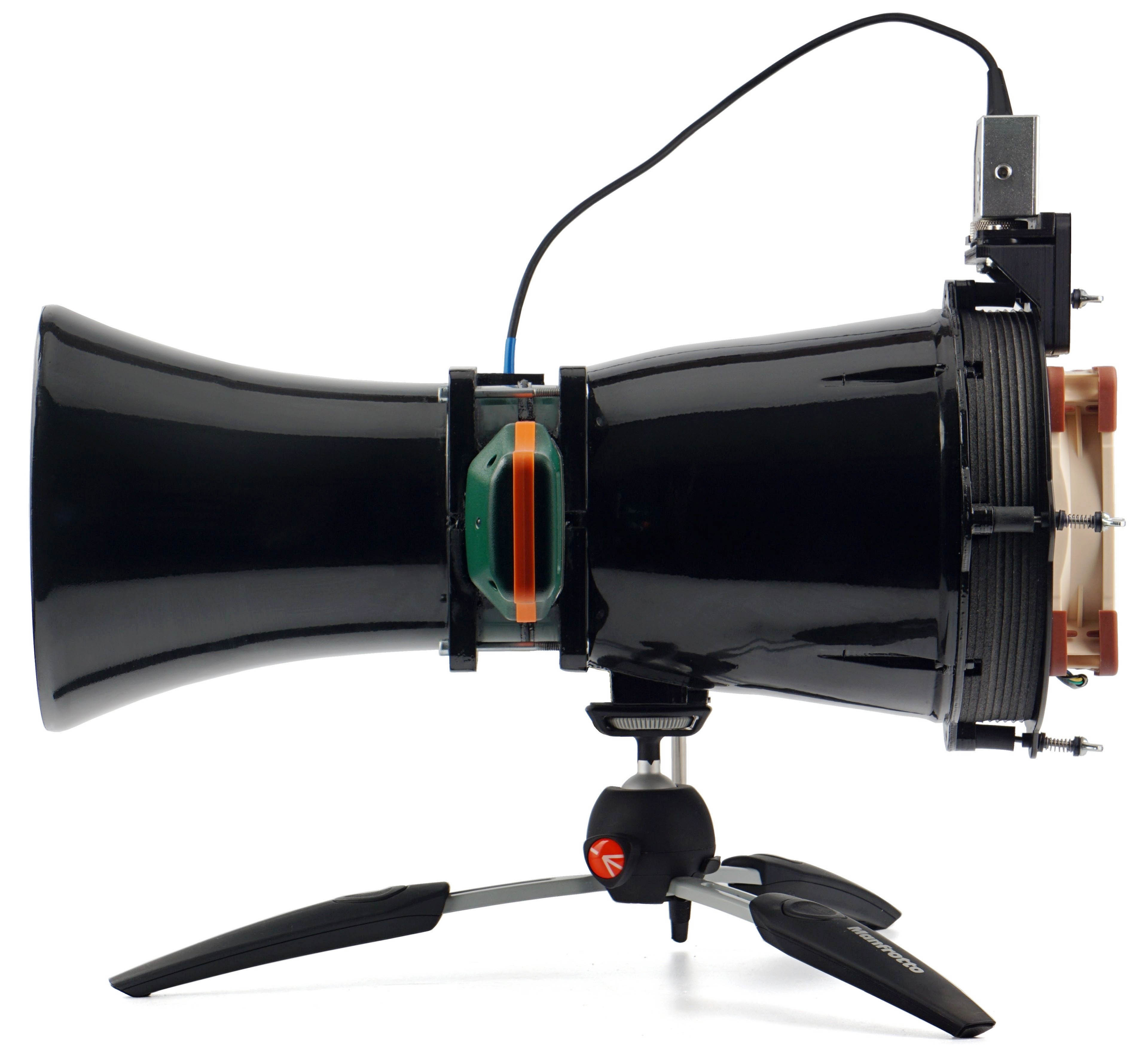
Now we will briefly elaborate on some things that do not fit thematically into the text of the following chapters. Namely, for example, that the skeleton of the wind tunnel is the work of a 3D printer (PLA). The rough print was, of course, then thoroughly machined by grinding, fusing, polishing and varnishing. Especially important is the smooth finish of the interior walls.
When joining the individual parts, the emphasis was on making sure that they fit together flawlessly, that they were sealed flawlessly (we will come back to this when we describe the test procedures for pressure measurement), but also that the joints were not loosened by use. Everything is disassemblable for servicing purposes, but it is ensured that the properties are maintained during use and, for example, even under the stress of vibration. The threads are secured with either lock nuts or thread-locking fluid. It depends on which is more suitable in which place.
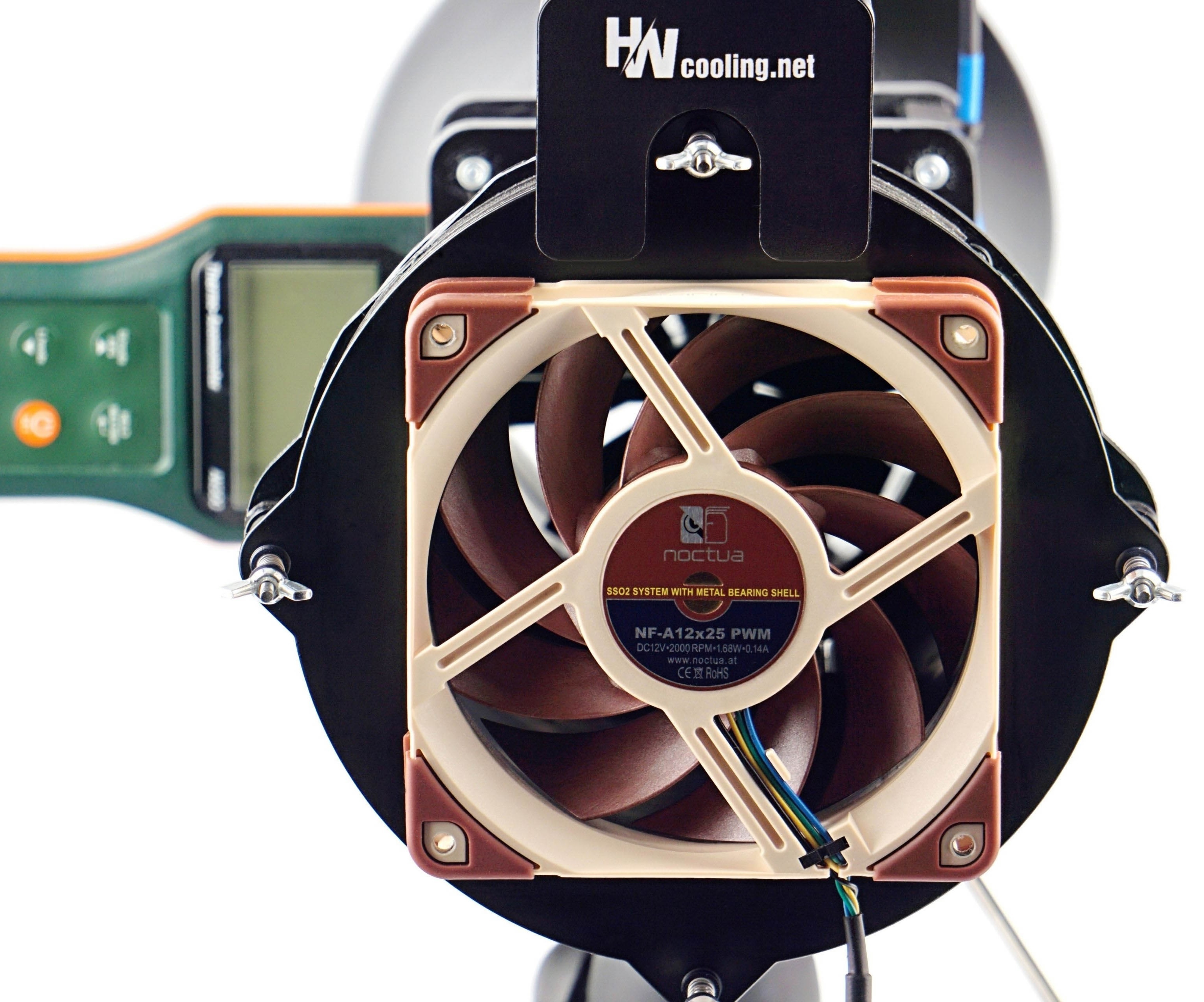
When the wind tunnel is not in use, it is enclosed in a dust-tight chamber. In addition to the technical equipment and its correct storage, it is also important for objective outputs that all measuring instruments are calibrated according to the standard. Without this, it would be impossible to stand behind your results and rely on the manufacturers’ specifications. Calibration protocols are therefore an important part of the methodology. Testing is carried out at an ambient air temperature of 21–21.3 °C, humidity is approximately 45 % (± 2 %).
Fans come to us for testing in at least two pieces of the same model. If the deviations of any of the measured values are greater than 5 %, we also work with a third or fourth sample and the average value is formed by the results of the fans that came out the most similar and the differences between them fit under 5 %.



A potentially huge problem for this fan is its longevity. I’ve seen quite a number of reports of them failing in large numbers only after a few months of usage, presumably due to bearing failure. Have you seen any signs of this happening on your units?
Even when ignoring this issue, I don’t see it being particularly competitive vs fans like Endorfy Stratus and Arctic P12. While airflow per price vs no obstacles is high, but the value decreases greatly if you look at airflow per price vs radiators, for example.
Even though I cannot assess longevity, I can assess the ratio of airflow to price. And especially when it comes to the ratio airflow to price on radiators, this ratio speaks in favor of the TL-C12C compared to the Stratus. The P12 is from another world, nothing can be compared to it 😀 . Moreover, I counted with the price that Ľubo states in the specification (in €). If we took the price of a three-pack even the P12 would sweat.
Every dBA lvl – https://imgur.com/bhNPXyJ
Average – https://imgur.com/G8EmutF
I would say that overall the TL-C12C is quite comparable to the Stratus (except for the lifespan, which I can’t assess). 😉
Here are the current best prices from geizhals.de (19-6-2025, 9:30 am)
https://imgur.com/ppoJbo2
Yes, the price of the TL-C12C in the triple pack is extremely attractive. However, I assume that a fan hub will not be included in the standard accessories, as is sometimes the case with more expensive models. Here it will probably rely on the possibility of daisy-chaining and connecting all three fans to one header on the motherboard or case (if the case has its own hub). 🙂
You’re right, I was not aware of the fact that the triple pack is priced so low. If C12C works well long term, I can see them being quite attractive.
Good point. Unfortunately, we cannot assess lifespan. I’ve played around with the idea of creating some form of methodology based on “accelerated aging”, but under our conditions, that would not be easy… Recently, my colleague and I talked about fluid dynamic bearings and yes, the quality level can vary. This is also reflected in the wide range of MTBF/MTTF values… so yes, in the case of the TL-C12C, it’s probably a bit weaker here, but that probably also applies to the Stratus 120 PWM fans. Those are also low-end, but aerodynamically excellent, and I think both deserve the Smart Buy! award (the fans). Arctic P12, as Bufo points out, is “from another world”, but we should keep in mind that this might not be the case for much longer. It depends on how long Arctic continues to sell and supply them to third-party retailers. 🙂
According to this source, the “S-FDB” aka “Stably-Fluid Dynamic Bearing” is just a rifle bearing with a 20k hr MTTF… That could explain the poor longevity.
https://en.namu.wiki/w/Thermalright/%EC%BF%A8%EB%A7%81%ED%8C%AC
Thanks for the clarification. You’re right — not all FDBs are created equal. That’s also why the range of MTBF values (with FDB) is so wide. 🙂
as one fictional character said 😉
Bearing is bearing.
Rifle, Fluid, Hydro …
Makes no difference.
The degree is arbitrary.
The definition’s blurred.
or something like that … 😀
(message for Ľubo…you don’t have to resolve the differences…this is just for relief) 😀
Just want to say THANK YOU! This info doesn’t show up anywhere nor prominently in search engine results when researching lifetime of these Thermalright fans. Now it also makes sense why the E12B V3 model stops after 4 seconds on max RPM when the power is cut. With an Arctic P14 I saw it’s over 12 seconds. Makes sense now. Feeling pretty disappointed how misleading Thermalright is with the “FDB” claim…