


So, we have results for a Thermalright fan. While the first attempt (or second, if we count the now-discontinued model X-Silent 120) didn’t quite hit the mark, it’s probably fair to say that this is a more attractive option than the Scythe Kaze Flex II 120. Yes, these two fans are being directly compared because they share an unusual trait – they spin in the “reverse” direction, from left to right. And as you know, most fans spin the other way…
Base 6 equal noise levels…
There are several options by which to normalize the test modes for fans. In the previous chapter, we wrote that perhaps the least appropriate option is equal speed.
Settings according to the same static pressure or flow are for consideration, but we find it most sensible in the long term to normalize the measurement modes according to the same noise levels. Firstly because decibels are a logarithmic unit and all others scale linearly, but mainly because you can orientate fastest by the same noise levels. The easiest way to compare the efficiency of fans is just by how they perform at the same sound pressure level. Of all the options, this is the one that most people can best imagine and bounce off of when considering other variables.
The individual noise level modes are adjusted from low levels continuously to higher levels. All users will find their results in the tests, regardless of whether they prefer very quiet operation at the limit of audibility or whether high performance is paramount.
The quietest mode corresponds to 31 dBA, followed by 33 dBA, and for each additional mode we add 3 dBA, which always doubles the noise level (36, 39, 42 and 45 dBA). Finally, we measure the fans at maximum power. Here, each one already has a slightly different noise level, which we also report. If there are missing measurements between the results for any of the fans, this means that it was not possible to set the target noise level. Either because its minimum speed exceeds the quietest mode of 31 dBA or vice versa because the fan is quieter than 45 dBA at maximum power.
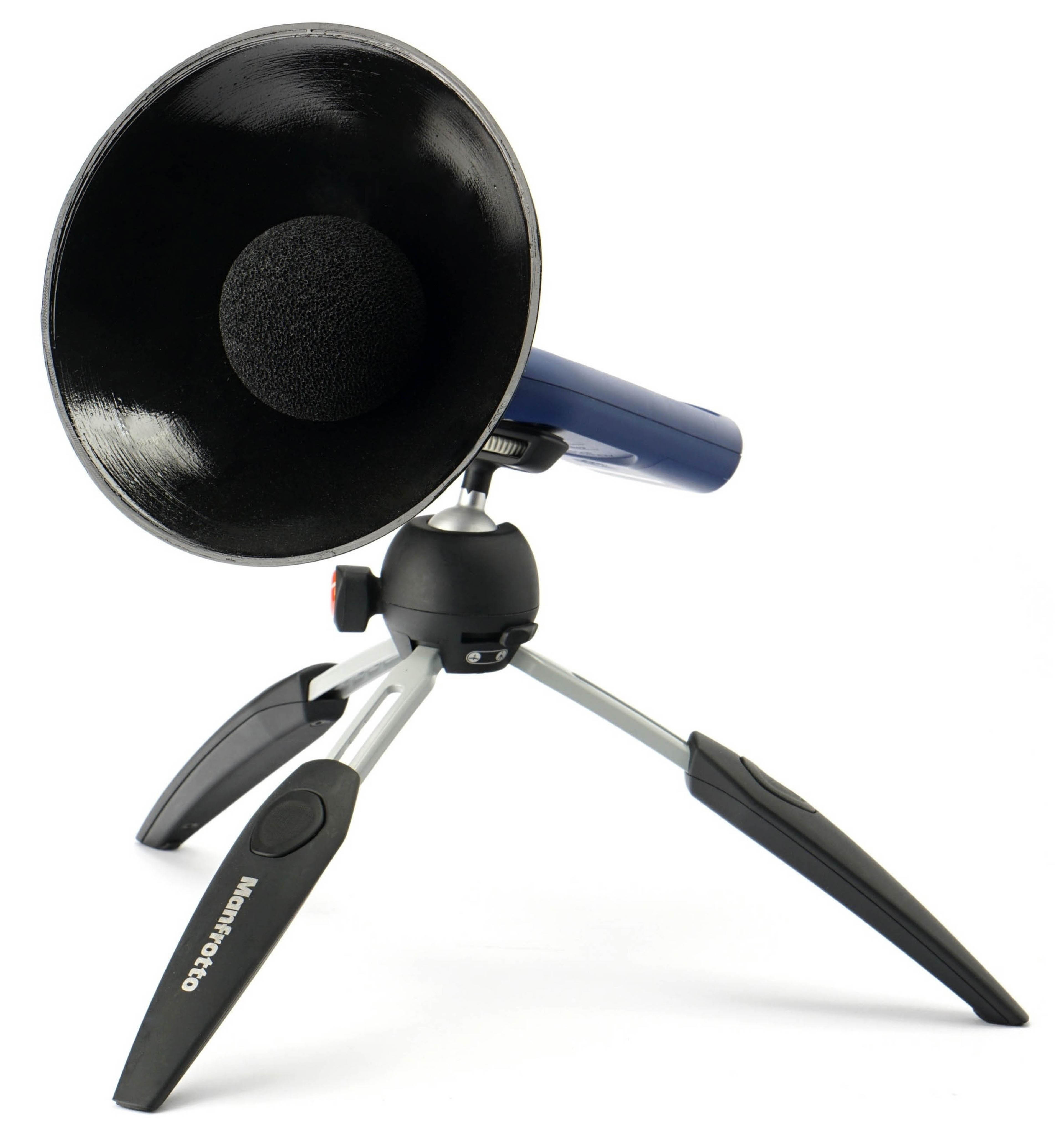
It is important to add that our noise level measurements are incomparable to the values quoted by the fan manufacturers in their specifications. One of the reasons is because we use a parabola-shaped collar around the sensor of the noise meter, which increases sensitivity. This is important in order to distinguish and set to the same noise level even modes at very low speeds, especially 31 dBA.
The noise meter next to the fan is quite close for sufficient resolution. The distance between the frame and the sensor is 15 centimeters. The sensor is positioned in such a way that there is no distortion or that the noise level measurements are not affected by airflow. Therefore, the noise meter is centered perpendicularly to the frame that defines the depth of the fan. Everything is always at the same angle and at the same distance. We use an inclinometer and markers to set the distances precisely and always the same.

We use a Reed R8080 noise meter to measure noise levels. This allows real-time averaging of samples, which is important for fine-tuning individual modes. We tune the fans until the specified noise level is reached to two decimal places, for example 31.50 dBA. The noise meter is the only instrument we calibrate inside our testlab. The other instruments have been calibrated by the relevant technical institutes. However, in the case of the noise meter, calibration is required before each test and we therefore have our own calibrator. This is already calibrated externally according to the standard.




A potentially huge problem for this fan is its longevity. I’ve seen quite a number of reports of them failing in large numbers only after a few months of usage, presumably due to bearing failure. Have you seen any signs of this happening on your units?
Even when ignoring this issue, I don’t see it being particularly competitive vs fans like Endorfy Stratus and Arctic P12. While airflow per price vs no obstacles is high, but the value decreases greatly if you look at airflow per price vs radiators, for example.
Even though I cannot assess longevity, I can assess the ratio of airflow to price. And especially when it comes to the ratio airflow to price on radiators, this ratio speaks in favor of the TL-C12C compared to the Stratus. The P12 is from another world, nothing can be compared to it 😀 . Moreover, I counted with the price that Ľubo states in the specification (in €). If we took the price of a three-pack even the P12 would sweat.
Every dBA lvl – https://imgur.com/bhNPXyJ
Average – https://imgur.com/G8EmutF
I would say that overall the TL-C12C is quite comparable to the Stratus (except for the lifespan, which I can’t assess). 😉
Here are the current best prices from geizhals.de (19-6-2025, 9:30 am)
https://imgur.com/ppoJbo2
Yes, the price of the TL-C12C in the triple pack is extremely attractive. However, I assume that a fan hub will not be included in the standard accessories, as is sometimes the case with more expensive models. Here it will probably rely on the possibility of daisy-chaining and connecting all three fans to one header on the motherboard or case (if the case has its own hub). 🙂
You’re right, I was not aware of the fact that the triple pack is priced so low. If C12C works well long term, I can see them being quite attractive.
Good point. Unfortunately, we cannot assess lifespan. I’ve played around with the idea of creating some form of methodology based on “accelerated aging”, but under our conditions, that would not be easy… Recently, my colleague and I talked about fluid dynamic bearings and yes, the quality level can vary. This is also reflected in the wide range of MTBF/MTTF values… so yes, in the case of the TL-C12C, it’s probably a bit weaker here, but that probably also applies to the Stratus 120 PWM fans. Those are also low-end, but aerodynamically excellent, and I think both deserve the Smart Buy! award (the fans). Arctic P12, as Bufo points out, is “from another world”, but we should keep in mind that this might not be the case for much longer. It depends on how long Arctic continues to sell and supply them to third-party retailers. 🙂
According to this source, the “S-FDB” aka “Stably-Fluid Dynamic Bearing” is just a rifle bearing with a 20k hr MTTF… That could explain the poor longevity.
https://en.namu.wiki/w/Thermalright/%EC%BF%A8%EB%A7%81%ED%8C%AC
Thanks for the clarification. You’re right — not all FDBs are created equal. That’s also why the range of MTBF values (with FDB) is so wide. 🙂
as one fictional character said 😉
Bearing is bearing.
Rifle, Fluid, Hydro …
Makes no difference.
The degree is arbitrary.
The definition’s blurred.
or something like that … 😀
(message for Ľubo…you don’t have to resolve the differences…this is just for relief) 😀
Just want to say THANK YOU! This info doesn’t show up anywhere nor prominently in search engine results when researching lifetime of these Thermalright fans. Now it also makes sense why the E12B V3 model stops after 4 seconds on max RPM when the power is cut. With an Arctic P14 I saw it’s over 12 seconds. Makes sense now. Feeling pretty disappointed how misleading Thermalright is with the “FDB” claim…