


This is a first – a fan with the leading edges of the impeller blades on the opposite side to normal ones. This is primarily done for a better view of “fans without stator struts” in cases with glass side panels. In addition, such an unconventional design also has quite clear and measurable advantages and disadvantages, also in terms of functional characteristics. Let’s take everything in turn.
Base 6 equal noise levels…
There are several options by which to normalize the test modes for fans. In the previous chapter, we wrote that perhaps the least appropriate option is equal speed.
Settings according to the same static pressure or flow are for consideration, but we find it most sensible in the long term to normalize the measurement modes according to the same noise levels. Firstly because decibels are a logarithmic unit and all others scale linearly, but mainly because you can orientate fastest by the same noise levels. The easiest way to compare the efficiency of fans is just by how they perform at the same sound pressure level. Of all the options, this is the one that most people can best imagine and bounce off of when considering other variables.
The individual noise level modes are adjusted from low levels continuously to higher levels. All users will find their results in the tests, regardless of whether they prefer very quiet operation at the limit of audibility or whether high performance is paramount.
The quietest mode corresponds to 31 dBA, followed by 33 dBA, and for each additional mode we add 3 dBA, which always doubles the noise level (36, 39, 42 and 45 dBA). Finally, we measure the fans at maximum power. Here, each one already has a slightly different noise level, which we also report. If there are missing measurements between the results for any of the fans, this means that it was not possible to set the target noise level. Either because its minimum speed exceeds the quietest mode of 31 dBA or vice versa because the fan is quieter than 45 dBA at maximum power.
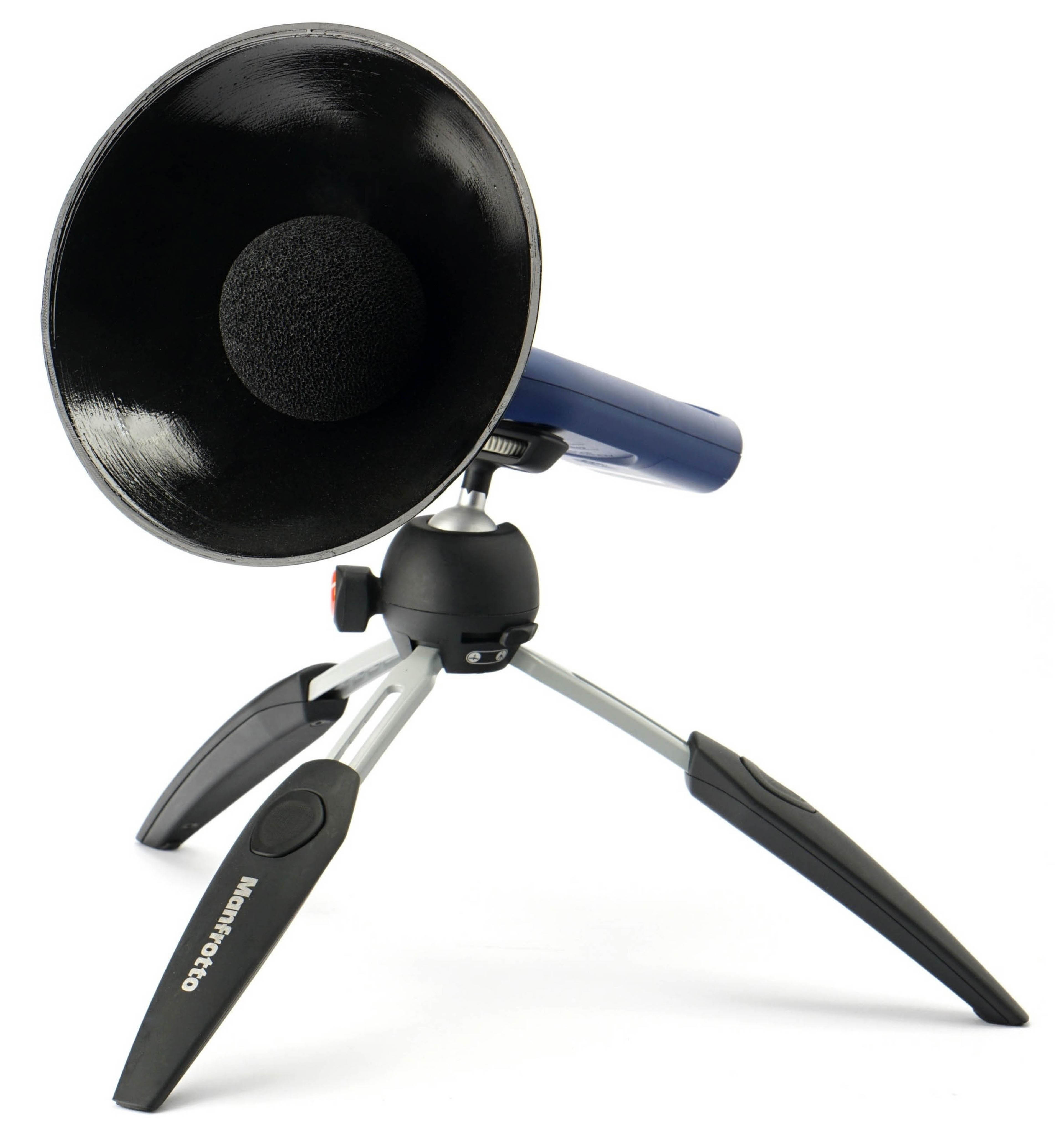
It is important to add that our noise level measurements are incomparable to the values quoted by the fan manufacturers in their specifications. One of the reasons is because we use a parabola-shaped collar around the sensor of the noise meter, which increases sensitivity. This is important in order to distinguish and set to the same noise level even modes at very low speeds, especially 31 dBA.
The noise meter next to the fan is quite close for sufficient resolution. The distance between the frame and the sensor is 15 centimeters. The sensor is positioned in such a way that there is no distortion or that the noise level measurements are not affected by airflow. Therefore, the noise meter is centered perpendicularly to the frame that defines the depth of the fan. Everything is always at the same angle and at the same distance. We use an inclinometer and markers to set the distances precisely and always the same.

We use a Reed R8080 noise meter to measure noise levels. This allows real-time averaging of samples, which is important for fine-tuning individual modes. We tune the fans until the specified noise level is reached to two decimal places, for example 31.50 dBA. The noise meter is the only instrument we calibrate inside our testlab. The other instruments have been calibrated by the relevant technical institutes. However, in the case of the noise meter, calibration is required before each test and we therefore have our own calibrator. This is already calibrated externally according to the standard.



Any plans for tests of the non-reverse variant, and also spacers (like Noctua NA-IS1)? To me they would be the logical next steps for topics raised in this test.
We do not plan to test the standard variants of TR120 fans in the near future. In the long run, the basic plan remains the same – we have to compare all the fans that exist, haha. Only time will tell where we will really end up. 🙂
We’ve had the NA-IS1 frames in our editorial office since their introduction. Of course it would be really useful to get to them and one day it will come. I still can’t make space for them – there is always something “more important”.
Always looking forward to your tests, whatever they are🙂
One additional question though, could you further elaborate what’s going on with the hexagonal grille tests for this fan? First time I’ve seen a fan that somehow has parts of the data missing in the middle (33 and 36 missing, but not 31 and 39). You say unstable tonal peaks, so is the RPM unstable at those noise levels, or is it due to something else?
I think it’s happened before. But maybe it was for the quietest or loudest mode of normalised noise and then it can be attributed to another reason? Anyway, I will explain.
It is important to realize how we bring the fans to the “same noise level”. It’s not like we set the fan somehow and it’s stable at, say, 36 dBA. It’s that we set the fan so that the average of 30 samples ends up at 36 dBA. The interval of these samples can be in the range of 35,9–36,1 dBA during the measurements, for example, but possibly also in a much wider range, for example 32–38 dBA, and now I am not exaggerating. This latter case is similar to trying to get the TR120 into the 33 and 36 dBA modes, which failed. With no PWM setting (nor after very fine tuning of the pulse strength with voltage in single digits of mV), we could not set the fan on the grille so that the average of 30 samples corresponds to 33 dBA and 36 dBA, respectively. It was always more or less, i.e. not what was required. This is a topic that certainly makes sense to look at in more detail. Especially after Noctua opened this “Beat frequency theory” topic, which is a good basis for understanding the issue by a wider than very narrow spectrum of users.
–“Beat frequency theory”
…well, already during the 1st world war the company on the bridge had to stop marching in order not to shake the bridge.
Wave interferance
https://en.m.wikipedia.org/wiki/Wave_interference
In acoustic
https://en.m.wikipedia.org/wiki/Beat_(acoustics)
Thanks for your detailed explanation. The only other time I have heard the need of averaging noise samples is from ThermalLeft. What’s the sampling rate you’re using?
This phenomenon is definitely worth looking into some day, especially for instances like this where large deviations occur.
The sampling rate of the Reed R8080 is 1s. The settings for the individual modes normalized according to a fixed noise level are based on the arithmetic mean of a 30-second recording. This must always be exactly 31.0; 33.0; 36.0; 39.0; 42.0 or 45.0 dBA after rounding.