


Low-profile fans are a special category, but sometimes they are unavoidable in more confined spaces. For technical reasons, it’s always about compromises compared to more respectable fans of normal thickness, but their weight can vary. If the Arctic P12 Slim and Alphacool SL-15 don’t fit your needs, the Scythe Kaze Flex II 120 Slim may be the closest thing to what you’re looking for.
How we measure power draw…
Is it worth addressing the power draw of fans? If you have seven of them in your computer (three on the radiator of the cooler and four for system cooling in the case) and they are also backlit, the power draw starts at tens of watts. This makes it worth dealing with.
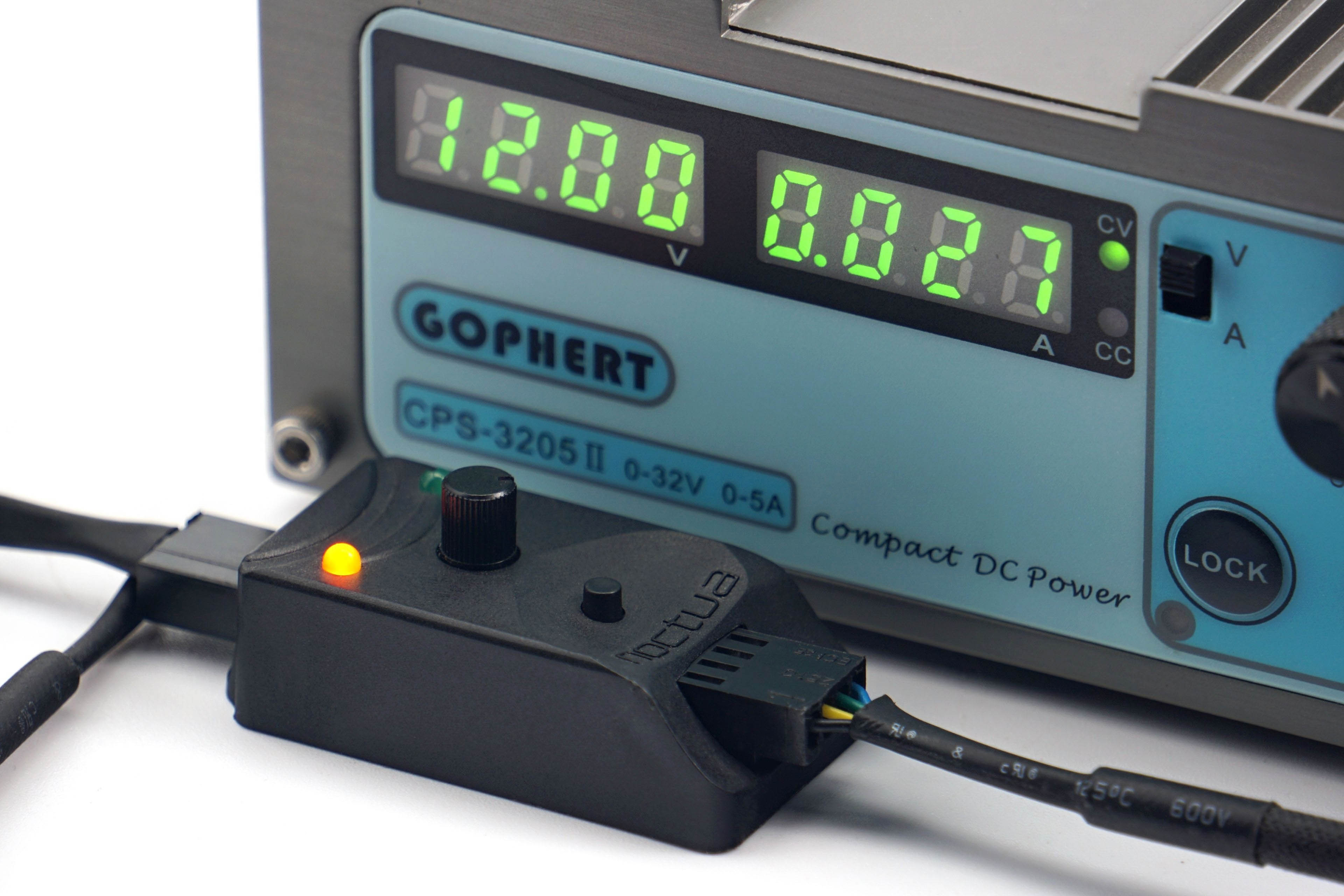
All fans are powered by Gophert CPS-3205 II laboratory power supply. It is passive and virtually noiseless, so it does not distort our noise level measurements. However, for the PWM fans, a Noctua NA-FC1 controller is connected through which the fans are regulated. We also have a shunt between the power supply and the Noctua controller. On it, we read the voltage drop, from which we then calculate the current. However, the voltage on the power supply is set so that 12 V goes to the Noctua NA-FC1. We then also set the exact 12 V to measure the maximum power of the 3-pin linear power supply fans.
In the power draw tests, we will be interested in the power draw in fixed noise level modes in addition to the maximum power consumption at 12 V or 100% PWM. That is, at those settings at which we also measure other parameters. Finally, in the graphs you will also find the power consumption corresponding to the start-up and minimum speeds. The difference between these two settings is that at start-up speed you need to overcome the frictional forces, so the power draw is always higher than at minimum speed. At these, the fan is already running and just reduces power to just before a level where it stops.

These start-up and minimum power draw data are a substitute for the start-up and minimum voltage information. You often encounter this when reading about fans, but with PWM fans there is no point in dealing with it. And although it is possible to power a PWM fan linearly, it will always perform better with PWM control – lower starting and minimum speeds. Therefore, it would be unfair to compare these parameters for all fans using linear control. That way, fans with PWM would be disadvantaged and the results distorted.
…and motor power
In addition to power draw, it is important to consider one more parameter that is related to the power supply – the power of the motor. This is usually listed on the back on a label and is often mistaken for power draw. However, the voltage and current indication here is usually not about power draw, but about the power of the motor. The latter must always be well above the operating power draw. The more, the longer the life expectancy of the fan.
Over time and with wear, fan friction increases (through loss, hardening of the lubricant, dust contamination or abrasion of the bearings, etc.). However, a more powerful motor will overcome the deteriorating condition of the fan to some extent, albeit at a higher power draw, but somehow it will cope. However, if the difference between the motor power and the operating power draw of the new fan is small, it may no longer be able to exert sufficient force to turn the rotor under increased friction due to adverse circumstances.

To test the power of the motor, we set the fan to full power (12 V/100 % PWM) and increase the mechanical resistance by braking the rotor in the middle. This is a higher load for the motor, with which the power draw naturally increases. But this is only up to a point, until the rotor stops. The power of the motor in our tests corresponds to the highest achieved power draw that we observed when the fan was being braked.
We use the Keysight U1231A high sample rate precision multimeters to analyse motor performance (as well as normal operating power draw). In addition, the individual samples are recorded in a spreadsheet, from which we then graph the maximum. The final value is the average of three measurements (three maximums).




On the evaluation page, the link to frequency analysis on plastic filters was wrong (39 instead of 29). Also, the summary was wrongly replaced by the spec table.
On your evaluation of frequency, you say thay the weakness of the fan only shows when it runs above 1100 RPM (that is 45 dBA). But from reading the charts, there seems to be strong peaks that appear in 39 dBA mode (959 RPM) as well. Did I interpret the data incorrectly?
Thank you for the heads up. Corrected. Including the charts that were really messed up. I was already in advanced stages of exhaustion when I released it yesterday…
… you read the spectrographs well. Yes, you are right, even the 39 dBA (~959 rpm) mode is characterized by more pronounced tonal peaks, so I’ve modified that statement a bit. Below 850 rpm it’s fine in that respect. Approximately such speeds at 39 dBA correspond to tests with a plastic filter and on a grille, which increase the noise level, so when tuned to the same level the fan speeds will always be a bit slower than in a use case without an obstacle.
So thanks for this observation and apologies for the inaccurate interpretation of the results. I wrote the article a bit under pressure and at the same time on the verge of complete exhaustion. I hope that similar mistakes will be avoided in the future.
You don’t have to apologize, it does not take away from the fact that the overall analysis is great work.
Health is very important. I hope you’ll find time to take a good rest and don’t push yourself too hard 🙂. Take care.
Guys, please test 120 and 140x25mm Kaze Flex – they were highly praised by other (but not as advanced as you) reviewiers, especially as case fans. I generally really like them from my own experience for being solid performers; sounding well; having quiet motor and bearing and representing nice quality additionally proven by few years of using them in my own pc.
Sure, the 120 and 140 mm Kaze Flex II will be next in line as far as Scythe fans are concerned. I mean, maybe the Grand Tornado model, which is close to release, will fit in between them.