


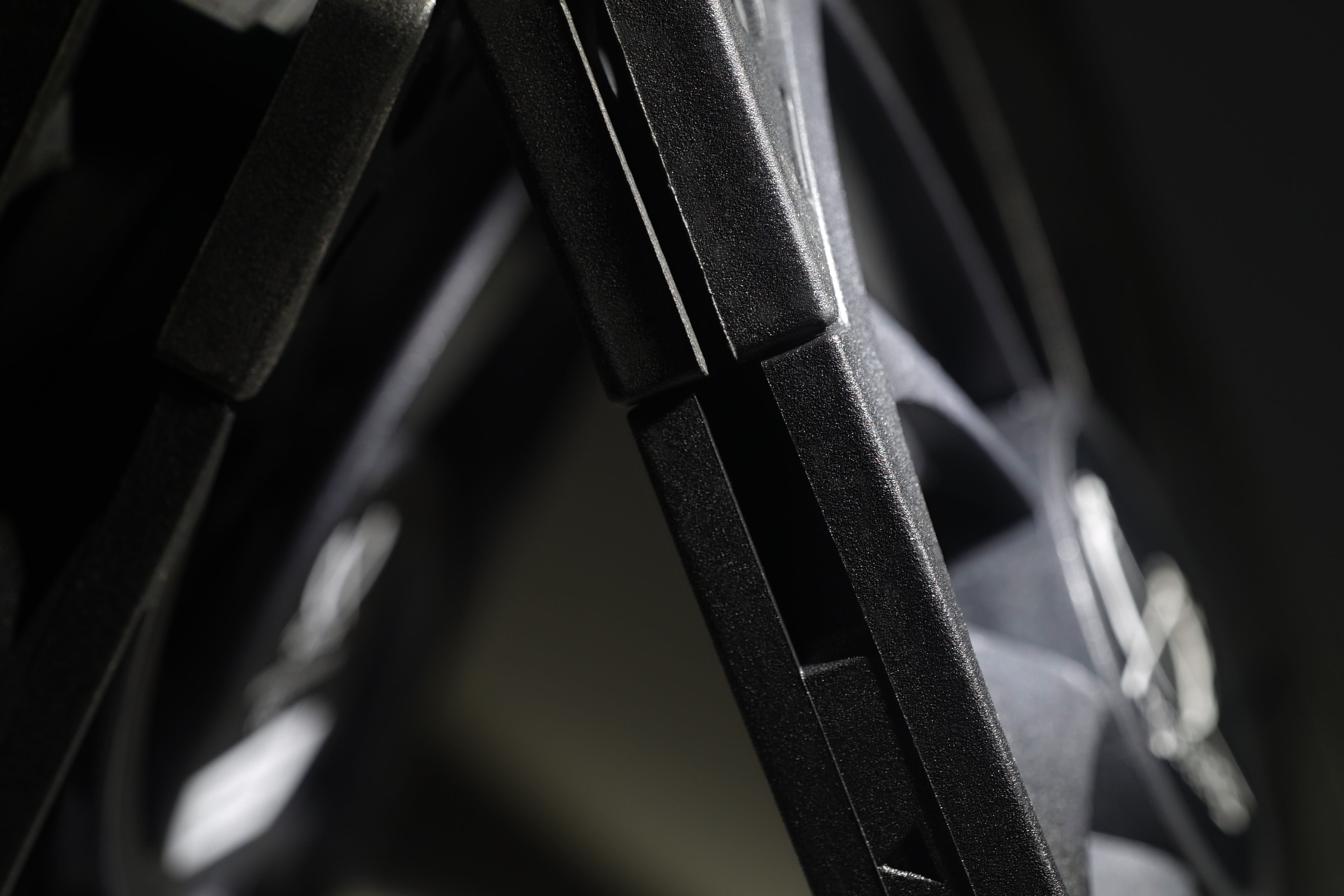
Low-profile fans are a special category, but sometimes they are unavoidable in more confined spaces. For technical reasons, it’s always about compromises compared to more respectable fans of normal thickness, but their weight can vary. If the Arctic P12 Slim and Alphacool SL-15 don’t fit your needs, the Scythe Kaze Flex II 120 Slim may be the closest thing to what you’re looking for.
Results: Airflow through a thinner radiator
Why is there a missing value sometimes? There may be more reasons. Usually it is because the fan could not be adjusted to the target noise level. Some have a higher minimum speed (or the speed is low, but the motor is too noisy) or it is a slower fan that will not reach the higher decibels. But the results in the graphs are also missing if the rotor is brushing against the nylon filter mesh. In that case, we evaluate this combination as incompatible. And zero in the graphs is naturally also in situations where we measure 0.00. This is a common occurrence at extremely low speeds with obstructions or within vibration measurements.




On the evaluation page, the link to frequency analysis on plastic filters was wrong (39 instead of 29). Also, the summary was wrongly replaced by the spec table.
On your evaluation of frequency, you say thay the weakness of the fan only shows when it runs above 1100 RPM (that is 45 dBA). But from reading the charts, there seems to be strong peaks that appear in 39 dBA mode (959 RPM) as well. Did I interpret the data incorrectly?
Thank you for the heads up. Corrected. Including the charts that were really messed up. I was already in advanced stages of exhaustion when I released it yesterday…
… you read the spectrographs well. Yes, you are right, even the 39 dBA (~959 rpm) mode is characterized by more pronounced tonal peaks, so I’ve modified that statement a bit. Below 850 rpm it’s fine in that respect. Approximately such speeds at 39 dBA correspond to tests with a plastic filter and on a grille, which increase the noise level, so when tuned to the same level the fan speeds will always be a bit slower than in a use case without an obstacle.
So thanks for this observation and apologies for the inaccurate interpretation of the results. I wrote the article a bit under pressure and at the same time on the verge of complete exhaustion. I hope that similar mistakes will be avoided in the future.
You don’t have to apologize, it does not take away from the fact that the overall analysis is great work.
Health is very important. I hope you’ll find time to take a good rest and don’t push yourself too hard 🙂. Take care.
Guys, please test 120 and 140x25mm Kaze Flex – they were highly praised by other (but not as advanced as you) reviewiers, especially as case fans. I generally really like them from my own experience for being solid performers; sounding well; having quiet motor and bearing and representing nice quality additionally proven by few years of using them in my own pc.
Sure, the 120 and 140 mm Kaze Flex II will be next in line as far as Scythe fans are concerned. I mean, maybe the Grand Tornado model, which is close to release, will fit in between them.