


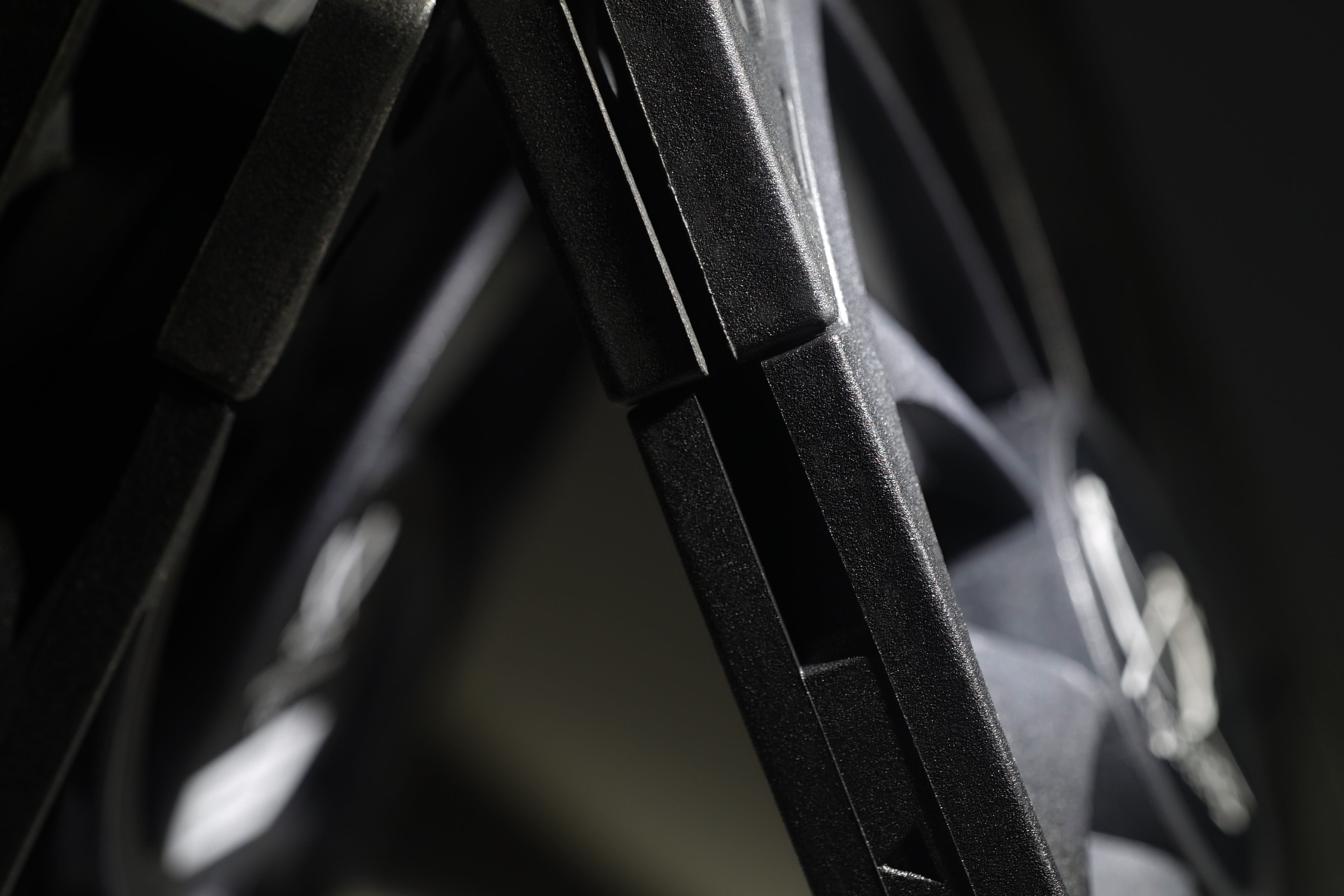
Low-profile fans are a special category, but sometimes they are unavoidable in more confined spaces. For technical reasons, it’s always about compromises compared to more respectable fans of normal thickness, but their weight can vary. If the Arctic P12 Slim and Alphacool SL-15 don’t fit your needs, the Scythe Kaze Flex II 120 Slim may be the closest thing to what you’re looking for.
Initial warm-up…
Before we even start measuring anything, we let the fans run “idle” for a few minutes after plugging them in. This is because immediately after a cold start the fans reach different parameters than after a certain amount of short-term operation.
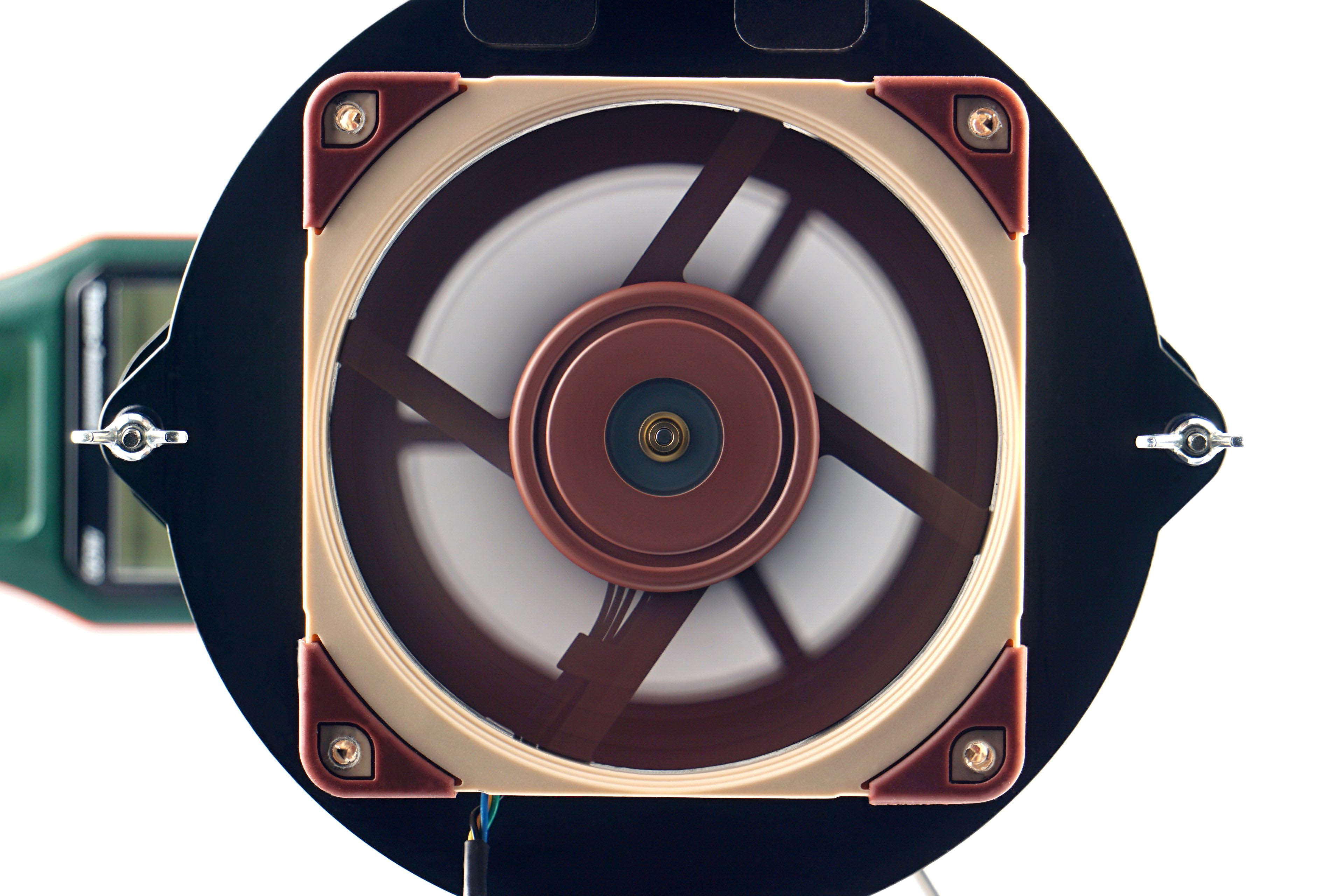
Until the operating temperature of the lubricant is stabilized, a typically lower maximum performance is achieved. This is because at lower temperatures the lubricant is denser, which is associated with higher friction. Therefore, the fans do not reach maximum speed immediately, but only after the first few seconds. Before the first measurements, we therefore leave the fans running for at least 300 seconds at 12 V, or 100 % PWM intensity.
…and speed recording
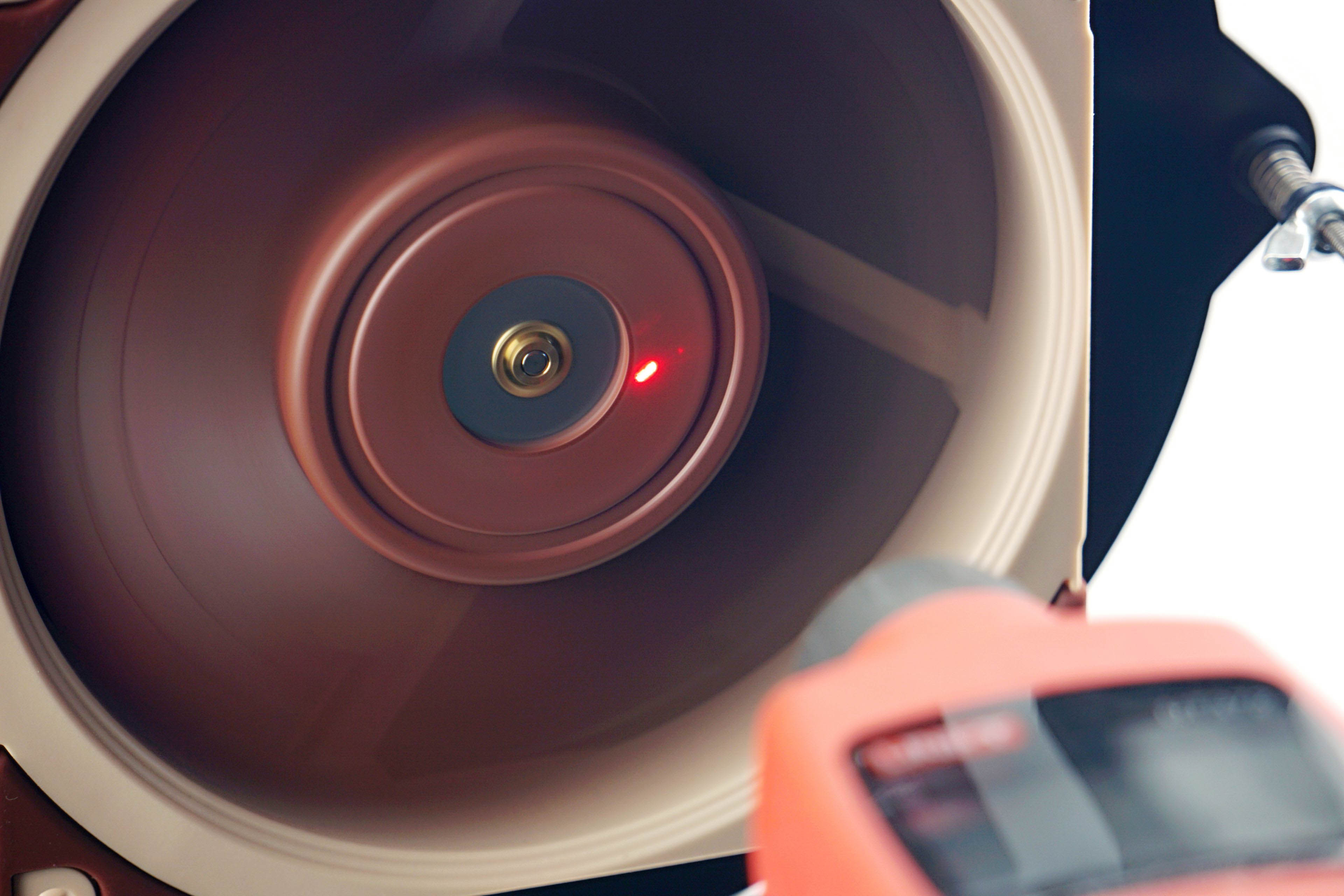
The speed of the fans is monitored using a laser tachometer, which reads the number of revolutions from a reflective sticker on the rotor. For this purpose, we use the UNI-T UT372 device, which also allows real-time averaging of samples. Thus, we do not record the peak value in the graphs, but the average speed value from a 30-second time period.
However, the speed itself is a relatively unimportant parameter that is often given more attention than is appropriate. This is the case even in many fan or cooler tests, where speed is used to normalize the different modes in which other variables are measured.
However, hyper-focusing on a specific speed is a rather unfortunate decision if only because the fans don’t gain any commonality. At the same speed all other variables are different, there is no intersection. It can be noted that a better normalization would have been by any other variable, whether it be static pressure, flow or noise level, which wins in our case. But more on that in the next chapter.
We only measure the speed so that you can associate a particular parameter (such as the amount of static pressure or some noise level) with something according to which you can adjust the fan yourself. Perhaps for that alone, the information about the achieved speed is useful. As part of the fan analysis, we will also indicate what the fans’ starting and minimum speeds are. Start-up speeds tend to be higher than minimum speeds because more force is required to get the rotor moving than once the fan rotor is spinning, and a minimum power intensity is sought at which the fan does not stall.





On the evaluation page, the link to frequency analysis on plastic filters was wrong (39 instead of 29). Also, the summary was wrongly replaced by the spec table.
On your evaluation of frequency, you say thay the weakness of the fan only shows when it runs above 1100 RPM (that is 45 dBA). But from reading the charts, there seems to be strong peaks that appear in 39 dBA mode (959 RPM) as well. Did I interpret the data incorrectly?
Thank you for the heads up. Corrected. Including the charts that were really messed up. I was already in advanced stages of exhaustion when I released it yesterday…
… you read the spectrographs well. Yes, you are right, even the 39 dBA (~959 rpm) mode is characterized by more pronounced tonal peaks, so I’ve modified that statement a bit. Below 850 rpm it’s fine in that respect. Approximately such speeds at 39 dBA correspond to tests with a plastic filter and on a grille, which increase the noise level, so when tuned to the same level the fan speeds will always be a bit slower than in a use case without an obstacle.
So thanks for this observation and apologies for the inaccurate interpretation of the results. I wrote the article a bit under pressure and at the same time on the verge of complete exhaustion. I hope that similar mistakes will be avoided in the future.
You don’t have to apologize, it does not take away from the fact that the overall analysis is great work.
Health is very important. I hope you’ll find time to take a good rest and don’t push yourself too hard 🙂. Take care.
Guys, please test 120 and 140x25mm Kaze Flex – they were highly praised by other (but not as advanced as you) reviewiers, especially as case fans. I generally really like them from my own experience for being solid performers; sounding well; having quiet motor and bearing and representing nice quality additionally proven by few years of using them in my own pc.
Sure, the 120 and 140 mm Kaze Flex II will be next in line as far as Scythe fans are concerned. I mean, maybe the Grand Tornado model, which is close to release, will fit in between them.